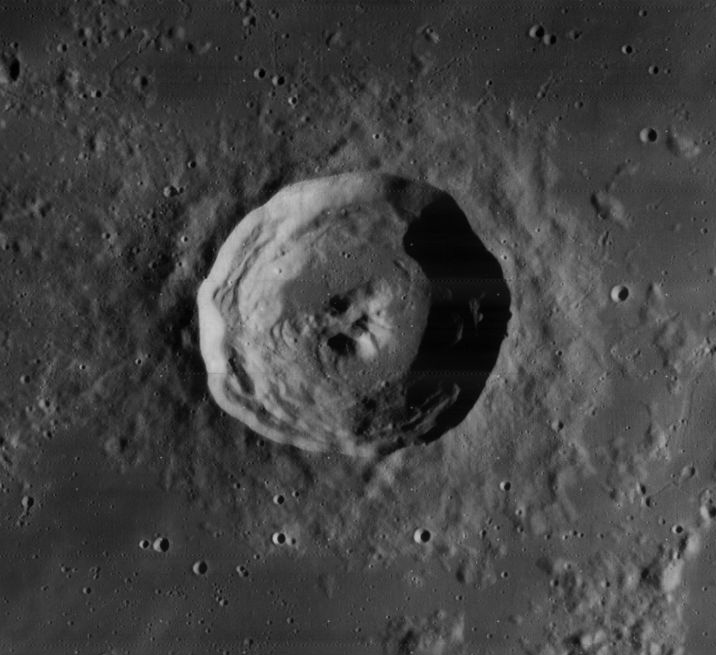
Using the newly-invented telescope, French astronomer Nicolas-Claude Fabri de Peiresc (1580-1637) discovered the now-famous Orion Nebula (M42) when he was 29 years old, 410 years ago on this day.
November 26, 1610.
But wait a minute. You and I can see a nebulous “star” below the belt of Orion with our unaided eyes under a reasonably dark sky. Why wasn’t this object discovered long before the invention of the telescope?
Apparently, there is no known report of a “nebulous star” in the sword of Orion prior to Peiresc’s discovery. Is the Orion nebula brighter now than it was a few centuries ago? Is it possible an earlier observational report somehow got missed or was not properly interpreted?
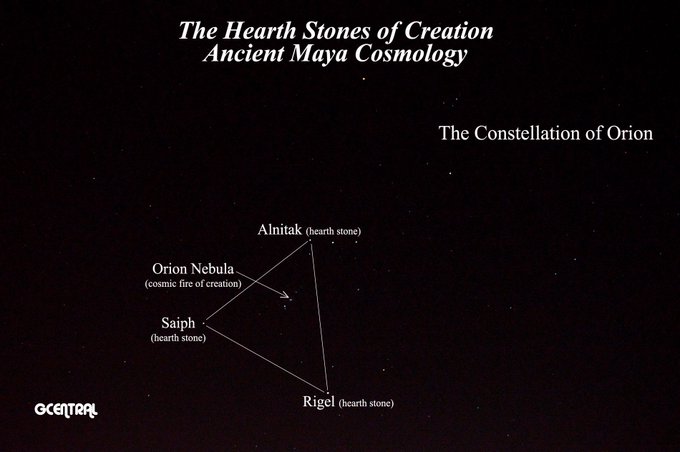
There is speculation that the Maya civilization of Mesoamerica recognized the Orion Nebula long before Peiresc’s discovery, describing it as smoke from the smoldering embers of creation.
One can only stand in wonderment at the knowledge and experiences of hundreds of generations of men, women, and children who are utterly unknown to us today. Passed from person to person and generation to generation through oral tradition, never written down and eventually lost. Or written down on documents that later disintegrated or were purposefully destroyed.
Who hasn’t wished that they could could time travel back to the past? Have you ever wondered what your current location looked like a hundred years ago? A thousand years ago? Ten thousand or more years ago? Though sending humans into the past will probably never be possible, who’s to say that we won’t eventually figure out a way to view and perhaps even hear the past, without actually being there or having the ability to change it?
Pittsburgh telescope maker, optician, and educator John Alfred Brashear (1840-1920) was born 180 years ago this day. His world-renowned optical company made much of the astronomical equipment in use in the United States during the late 19th and early 20th centuries. His works included a 30-inch refractor for Allegheny Observatory in Pittsburgh, a 15-inch refractor for the Dominion Observatory in Canada, and the 8-inch refractor at the Drake University Municipal Observatory in Des Moines, Iowa.
My good friend, telescope maker Drew Sorenson in Jefferson, Iowa, has been a fan of John Brashear for many years. Not only does Drew make fine refractors as did Brashear, but there is more than a little resemblance between the two men. Drew introduced me to a delightful book entitled John A. Brashear: The Autobiography of A Man who Loved the Stars, which was first published posthumously in 1924. For anyone interested in the history of astronomy and the life of a scientist and humanitarian who struggled from near-obscurity to great success with only an elementary school education, this book is a must-read.
Here are three of my favorite passages from the book.
Somewhere beneath the stars is work which you alone were meant to do. Never rest until you have found it.
There is another yarn I cannot resist telling. The young farmer who had been bringing Mrs. Brashear her supply of vegetables asked her one day if I would let him look in the big telescope if he came up some clear evening. She encouraged him to do so, and I found him waiting one night to see the sights. I did not know whether or not he had any knowledge of astronomy, but I asked him what he would like to look at. He replied, “Juniper.” I told him that unfortunately that planet was not visible in the sky at the time. Then he expressed a desire to see “Satan.” But his Satanic Majesty was not around either. The climax came when he asked if I could show him the “Star of Jerusalem!” I ended it by showing him the moon and some clusters, and he went home very happy.
I remember, too, an old gentleman over eighty years of age who climbed the hill one moonlight night for a look in the telescope. The good man was utterly exhausted when he reached the house, and Ma and I had him lie down on the lounge to rest before climbing the stairs to the telescope. The views that night were fine, and I can hear the soliloquy yet of the dear fellow as he said, “For many years I have desired to see the beauties of the heavens in a telescope. I have read about them and heard lectures about them, but I never dreamed they were so beautiful.” We invited him to stay all night; but as it was moonlight, and much easier for him to go down the hill than to come up, he insisted on going home. I went part of the way with him to see that he got along all right; and all the way he expressed his delight at having the wish of a lifetime gratified that night.
Three weeks later the funeral cortège of that old man passed along the road on the opposite hillside that led to the cemetery, and it has always been a pleasure to remember that I was able to be of some service in gratifying one of his desires of a lifetime.
I think that all my life I have been partial to old people and children, and it has always been a source of genuine pleasure to contribute to their happiness.
John A. Brashear: The Autobiography of A Man who Loved the Stars (1924)
One approach to establishing a dark-sky, astronomy-friendly, community is to find a small town in a rural area that would be receptive to doing the following:
Enact a comprehensive lighting ordinance that will be enforced
Obviously, this is going to be easier to do in a small community, and most likely one that is economically depressed.
What’s in it for them? What would the motivating factors be?
A commitment from X number of people that they would move to the community provided the community agrees to 1-3 above being done. Options for new residents would be to either purchase or rent an existing home/apartment/RV space/etc., or to build the same but land would have to be available.
The new residents would commit to working with the existing residents and businesses to improve the community and provide new opportunities, ensuring that this is a win-win situation for both existing and new residents.
The new residents would commit to doing some or all of the things outlined in the Mirador Astronomy Village specifications document, or something like it.
The influx of new residents and tourism will benefit all in the community, both economically and socially.
Does anyone know of a rural community that might be interested in putting their town “on the map” as an astronomy-friendly community for residents and visitors?
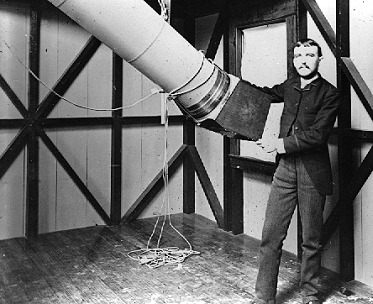
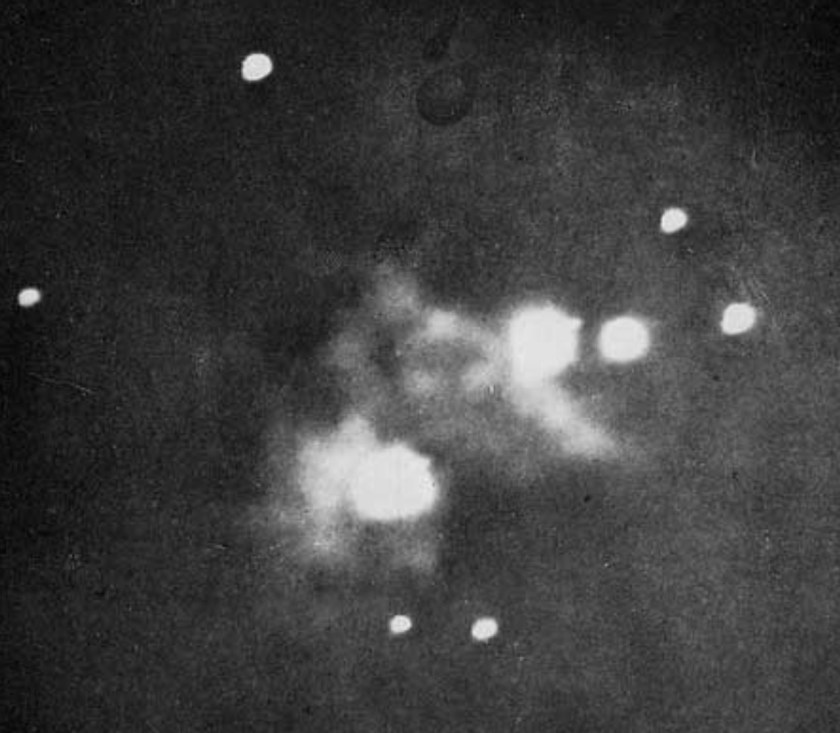
On this date 140 years ago, American physician and prominent amateur astronomer Henry Draper (1837-1882) made the first successful photograph of the Great Nebula in Orion, now usually referred to as the Orion Nebula. He used an 11-inch telescope (an Alvan Clark refractor!) and an exposure time of 50 minutes for the black and white photograph.
First photograph of the Orion Nebula, September 30, 1880. (Henry Draper)
Draper continued to improve his technique, and a year and a half later he obtained a 137-minute exposure showing much more detail.
Photograph of the Orion Nebula, March 14, 1882. (Henry Draper)
It really is amazing how image recording technology has improved over the past century and a half! At its best, film-based photography had a quantum efficiency of only about 2%, which means that only 2 out of every 100 photons of light impinging on the photographic medium is actually recorded. The rest is reflected or absorbed. The human eye—when well dark adapted—has a quantum efficiency of 15% or better, easily besting photography. Why, then, do photographs of deep sky objects show so much more detail than what can be seen through the eyepiece? The explanation is that the human eye can integrate photons and hold an image for only about 0.1 second. Film, on the other hand, can hold an image much longer. Even with reciprocity failure, photographic media like film can collect photons for minutes or even hours, giving them a big advantage over the human eye. But charge-coupled devices (CCDs) are a considerable improvement over older technologies since they typically have a quantum efficiency of 70% up to 90% or more. The CCD has truly revolutionized both professional and amateur astronomy in recent decades.
During the first half of 2020, I serendipitously captured a whopping nine meteors on my telescope’s 17 x 11 arcminute video field of view while observing potential asteroid occultation events. I used the method described in There’s a Meteor in My Image to determine the radiant for each meteor. Here they are.
Antihelion meteor 22 March 2020 UT; Field location UCAC4 575-024067 in Gemini Each frame is an exposure of 0.53s
The International Meteor Organization (IMO) identifies the antihelion source as “a large, roughly oval area of about 30˚ in right ascension and 15˚ in declination, centered about 12˚ east of the solar opposition point on the ecliptic, hence its name. It is not a true shower at all, but is rather a region of sky in which a number of variably, if weakly, active minor showers have their radiants.”
Sporadic meteor 10 Apr 2020 UT, Field location HD 119307 in Centaurus Each frame is an exposure of 0.13s
A sporadic meteor is any meteor that does not come from a known radiant.
Sporadic meteor 14 Apr 2020 UT, Field location UCAC4 387-065649 in Libra Each frame is an exposure of 0.27s (faint meteor in the upper right corner)Possible Eta Aquariid meteor 28 April 2020 UT; Field location UCAC4 326-064938 in Corvus Each frame is an exposure of 0.13sSporadic meteor or satellite? 8 May 2020 UT; Field location UCAC4 345-084929 in Ophiuchus Each frame is an exposure of 0.03s
Meteors enter the Earth’s atmosphere at a speed between 10 and 70 km/s, and burn up at an altitude of about 80 km. For a sight line perpendicular to the meteor’s path, the angular velocity should range between 7˚ and 41˚ per second. This means a meteor should cross the 17′ x 11′ field of my video camera in 0.03 seconds or less. Field traversal will take longer than this the closer the meteor is to its radiant or anti-radiant point.
The lowest stable altitude a satellite can orbit is about 200 km, where it will have an orbital velocity on the order of 8 km/s. This is slower than the slowest meteors. For a sight line perpendicular to the satellite’s path, the maximum angular velocity a satellite should have is about 2˚ per second.
Given these admittedly BOTEC calculations, one could reasonably conclude that if the object traverses the field in a single frame, it is probably a meteor. If not (and it is not an airplane), it is a satellite.
The object in the 8 May 2020 video does appear to be moving slow enough to be a satellite, but because it is traveling much faster than satellites usually do it must be orbiting quite low, close to re-entry. I was not able to identify the satellite, which is often the case for the fastest-moving satellites. My camera is sensitive enough to pick up tiny pieces of space debris orbiting at low altitude, and though these objects are no doubt catalogued by military organizations, they do not generally show up in the publicly-available orbital element datasets for satellites.
Antihelion meteor or satellite? 12 May 2020 UT; Field location UCAC4 585-130160 in Pegasus Each frame is an exposure of 0.27s
This one’s unusual in that there are two distinct “flare-ups” along the path. It is reasonably good match to the antihelion radiant for 12 May 2020, and though I have seen meteors experiencing outbursts along their paths, a more likely explanation for this event is that it is low altitude satellite with two “sun glint” events. What do you think?
Sporadic meteor 13 May 2020 UT; Field location UCAC4 348-150732 in Sagittarius Each frame is an exposure of 0.53sAntihelion meteor 17 June 2020 UT; Field location UCAC4 294-088825 in Lupus Each frame is an exposure of 1.07sSporadic meteor 18 June 2020 UT; Field location UCAC4 330-150629 in Sagittarius Each frame is an exposure of 0.53s
I was surprised to record so many meteors during the first half of 2020, as there is generally much less meteor activity between January and June than there is between July and December.
Since the beginning of February, I have been able dedicate 10+ hours each week towards creating an astronomy-friendly community called Mirador Astronomy Village. Will you join me in that effort?
And here are some recent posts I’ve made to Dark-Sky-Communities on groups.io (https://dark-sky-communities.groups.io/g/main) to give you an idea where we’re currently at with this exciting project.
Acquiring Land for Mirador Astronomy Village
The Mirador specifications document located in our Files section and here gives a lot of detail about our vision for an astronomy-friendly residential community and astronomy resort & learning center. But before any of this can be developed, we need to have land.
The next step for Mirador is to create a legal entity that can raise money for a land purchase.
Some challenges we face:
Mirador could be located in Arizona, New Mexico, or West Texas. We don’t want to limit our land search to one state, but incorporating in the state where land will be purchased is less complicated.
We need an attorney who is familiar with Arizona, New Mexico, and West Texas law, but especially with real estate law and corporate law.
Does anyone know an attorney who is interested in astronomy, might want to become involved with this project, and might be willing to do some pro bono work?
Does anyone know a fundraising professional who is interested in astronomy and might want to become involved with this project?
Our most immediate need is to find an attorney to help us create the legal entity that will be necessary to raise money for a land purchase. This legal entity will exist for one and only one purpose: to purchase land for Mirador Astronomy Village.
Here is what we currently envision for the land-purchase legal entity. Would appreciate your thoughts before we submit this to a prospective attorney.
Land Purchase
Issuance of Shares
1 share = $1000
No limit on the number of shares that can be purchased
Initial shares and additional shares can be purchased at any time
Hold the money in an FDIC-insured interest-bearing account
Value of shares remains unchanged except for interest accrued
Shareholders can return shares and remove their investment (plus interest) at any time up through the point of the shareholders voting in favor of making an offer on a property but before an offer is actually made
1 share = 1 vote
Funds can only be used to purchase a property for Mirador Astronomy Village; any leftover funds will be returned to the shareholders proportional to the number of shares they own.
If there are insufficient funds to purchase the property without financing, the shareholders will not be a party to that financing arrangement.
It is possible we may acquire land that is “partially donated”, that is the land owner may agree to sell us the land for the amount of funds we have raised to date.
Shareholders will be known as Community Founders.
After the property is purchased, the monetary value of the shares goes to $0.
Benefits for shareholders after the property is purchased will include free RV, camping, and astronomy access to the property as soon as it is acquired; after development, no-additional-cost benefits such as free access to astronomy programs will be offered.
Benefits will be proportional to the number of shares owned.
If Mirador Astronomy Village isn’t established on the property within five years, the property will be sold and the proceeds returned to the shareholders in proportion to the number of shares they own.
Some Reasons Why I Want to Live in a Dark-Sky Community
Posted 13 July 2020
I drove 20 miles round-trip early Saturday morning to view Comet NEOWISE (C/2020 F3) for the first time. It is beautiful! Easily visible to the unaided eye and spectacular in binoculars. And now, in the more convenient evening sky!
I had to trespass onto private land (as I often do) because we are not allowed to be in any of our state parks here in Wisconsin during the hours of 11:00 p.m. to 6:00 a.m. (unless you are a paid camper at a campsite).
One of my motivations for living in a dark-sky community is having a great view of a comet like C/2020 F3 literally right outside my door night after night. The same goes for watching meteors. The visibility of comets and meteors are severely impacted by light pollution—both the general urban skyglow but also nearby lights. Along with just about every other aspect of observational astronomy.
All my adult life I have spent significant time and energy educating (and becoming educated myself) about light pollution, environmentally-friendly lighting, and, of course, astronomy. There have been small victories, yes, but overall I feel my contributions have been a drop in the proverbial bucket.
Living in a “regular community” (as I have all my life), there is always the trepidation with every new neighbor or lighting technology change that your view of the night sky will be degraded even further than it already has, and there is not a darned thing you can do about it if the perpetrator (be it a neighbor or the city) chooses to marginalize you and your kindly-presented concerns. Heck, this can even be a problem living in a rural area. When I had my Outdoor Lighting Associates, Inc. business in Iowa from 1994-2005, I can’t count the many times I got a call from a distressed rural resident that had a new neighbor who decided to light up their place like Las Vegas.
Sure, a lighting ordinance would help a lot, but in most cities and towns these days they’ll look at you like you’re from Mars if you try to make enacting one a priority.
There are many advantages to living in a small community, but where I live now (population 4,700) there is no community will nor interest in reigning in bad lighting or in protecting the night sky. However, in 1999 I was deeply involved with writing a lighting ordinance and getting it approved in Ames, Iowa, a university town of 50,000 (at the time). Being a well-educated university town had a lot to do with our success there. Those were kinder, gentler times then, too.
Lighting at Mirador
I’d like to take this opportunity to explain more about the outdoor lighting aspects of an “astronomy-friendly” community. Indoor lighting would have no restrictions except the amount of light shining outdoors at night would need to be controlled with some sort of window covering.
Ideally, an astronomy-friendly community would not allow any dusk-to-dawn lighting. Why have a light shining all night long when most of the night no one will be making use of its illumination? Modern light sources such as LEDs, occupancy sensors, and control electronics have advanced to the point (both in terms of technology and affordability) that dusk-to-dawn lighting is no longer needed, at least not in the kind of small community we are talking about here. I would like Mirador Astronomy Village to be an ongoing demonstration project for the wider world showing a better way to do outdoor lighting. By “better” I mean lighting that provides needed illumination where and when it is needed without adversely affecting the nighttime environment, including our view of the night sky. By “better” I also mean using passive reflective or light-colored materials where possible to reduce the need for—or brightness of—outdoor lighting.
There’s a lot to be said in favor of using “personal lighting devices”, also known as flashlights, when walking about at night.
The permanent outdoor lighting that is installed should be properly shielded and directed so that only what needs to be illuminated is illuminated, thus eliminating glare, light trespass, and direct uplight. The right amount of light for the intended task should be used, never more than is needed.
We certainly will need to be mindful of anyone visiting or living in our community with vision limitations. This is most likely going to be an issue in the areas open to the public at night. Observational astronomers, as a general rule, have learned to see better at low illumination levels through familiarity and experience, but the same is not true for the general public. Accommodations will need to be made with this in mind, and I would expect the public areas to have more illumination.
Getting this project off the ground has been challenging in the midst of a pandemic. There is at least one of several things you can do right now to help this project along.
Post a comment here!
Join the Dark-Sky-Communities discussion group at https://dark-sky-communities.groups.io/g/main. There are several subscription options for your convenience, and even if you subscribe to receive individual emails, the traffic on this moderated group is light and focused specifically on astronomy-friendly residential communities.
Take the time to read through the detailed Mirador Astronomy Village specifications document.
Send me an email at DaveDarkSky@mac.com or call me at 608-930-2120 to discuss.
Spread the word! There may be only a half a dozen people in the United States who can help me to make Mirador Astronomy Village a reality. How do I reach them?
Finally, a bright comet! Comet C/2020 F3 NEOWISE was discovered on March 27, 2020 by the NEOWISE space telescope. NEOWISE (Near-Earth Object Wide-field Infrared Survey Explorer) is the current extended “warm” mission of WISE after its hydrogen coolant became depleted.
Currently visible in the morning twilight sky, Comet NEOWISE is already a naked-eye object and is spectacular in binoculars, low in the NE, below and a little to the left of the bright star Capella. Soon it will be moving into the evening sky, though it is expected to diminish in brightness somewhat as it gets further from the Sun. Here’s an ephemeris for Comet NEOWISE for July and August showing when it will be at least 10˚ above the horizon in a sky that is not brightened by either twilight or moonlight. Avoiding light pollution, however, is up to you. Enjoy!
Comet naming these days is a mess! For one, some of the acronyms used for the automated surveys that discover them are unattractive. Thank heavens neither of the two comets named ASASSN (C/2017 O1 and C/2018 N2) ever became as bright as our current comet!
There were three comets NEOWISE in 2014, three in 2015, three in 2016, one in 2017, two in 2018, two in 2019, and one (so far) in 2020.
Comet NEOWISE (C/2020 F3) 19 July 2020 3:21:59 UT 30s 55 mm f/4 ISO 1600 Canon EOS 100D Photo by David OesperComet NEOWISE (C/2020 F3) 20 July 2020 3:38:57 UT 3m 55 mm f/4.5 ISO 1600 Canon EOS 100D Photo by David OesperComet NEOWISE (C/2020 F3) 23 July 2020 3:22:17 UT 2m 55 mm f/4 ISO 1600 Canon EOS 100D Photo by David Oesper
Some meteor showers give a more-or-less reliable performance the same time each year, but others have an occasional year with (sometimes substantial) activity punctuating many years with little or no activity. The June Boötids, which may or may not be visible this weekend, is one such shower. The expected worldwide peak this year is Saturday, June 27 around 5 p.m. CDT. Though the radiant is above the horizon all night, the best two hours to watch will be from around 1:00 to 3:00 a.m. Sunday morning. (Moonset is at 1:11 a.m. and morning twilight begins at 3:06 a.m. at Dodgeville, CDT.)
One hallmark of the June Boötids is that they are unusually slow meteors, so they’re easy to identify if you see one. Look for the meteors to emanate from a region of the sky a few degrees north of the top of the “kite” of Boötes. Enjoy the process, even if you don’t see any meteors. The weather is pleasant at night this time of year, so get out there and observe!
A few years ago, I was doing some telescope sweeping of the meridian sky around declination -6˚ when, to my surprise and delight, a 10th- or 11th-magnitude slow-moving object entered my field of view. As it slowly traversed eastward through the field, I remembered the declination I was pointed to and realized that it must be a geostationary, or at least a geosynchronous, satellite. Centering the moving object and then turning off the telescope’s clock drive confirmed my suspicions. The object was a geosynchronous satellite because it appeared to lay motionless while all the stars in the field drifted toward the west. Serendipity is the spice of life!
Satellites stationed in orbits that are always directly above the Earth’s equator and that have an orbital period of 23h 56m 04.0905s (one sidereal day) have the interesting property of remaining stationary as seen from any point on the surface of the Earth. This property of geostationary satellites, as they are called, is used to great advantage by many communications and weather satellites. There are currently at least 554 satellites in geosynchronous orbits. They are stationed all around the Earth at various longitudes.
At what altitude do geostationary satellites orbit the Earth? It is well above human-occupied spacecraft like the International Space Station which currently orbits 260 miles above the Earth’s surface. Geosynchronous orbit lies some 22,236 miles above the Earth’s equator. This is quite a ways out, as the entire Earth subtends an angle of only 17° 12′ at this distance—about the same as the angular distance between Capella (α Aur) and Elnath (β Tau).
Looking at it another way, geostationary satellites orbit at an altitude that is 2.8 Earth diameters above the equator. Since the Moon orbits at a distance that ranges between 27.4 and 31.4 Earth diameters above the Earth’s surface, geosynchronous orbit is about 1/10 of the way to the Moon.
If you have a telescope, know where to point it, and turn tracking off, you can see a geostationary satellite as a stationary point of light while the stars drift by due to the Earth’s rotation. At our latitude here in southern Wisconsin (43° N), the area where you want to search for geostationary satellites (near the meridian) is around declination -6° 37′. Remember, declination tells you how many degrees above or below the celestial equator an object is, and the numbers range from -90° to +90°, the south celestial pole and north celestial pole, respectively. The celestial equator has a declination of 0°.
For any latitude1, the declination you want to search is given by
where δgs is the declination of the geostationary satellite in degrees and ϕ is your latitude in degrees
Since most calculators don’t have the cosecant (csc) or cotangent (cot) functions, this formula can be rewritten in a slightly more complicated form as
Why aren’t the satellites right on the celestial equator (δ = 0°)? They would be if they were millions of miles away or if we were located on the Earth’s equator, but at our northern latitude trigonometric parallax causes us to see the satellites somewhat below the celestial equator, relative to the distant stars.
What if the geostationary satellite is situated east or west of your meridian? How do you calculate its declination then? As you might expect, because the range (observer-to-satellite distance) is greater the further from the meridian the satellite is, the less the parallax is, and therefore the closer the declination is to the equator, though not by a lot. The declination is also symmetric about the meridian, east and west: a geostationary satellite one hour east of the meridian will have the same declination as another geostationary satellite one hour west of the meridian.
If you know the longitude of the geostationary satellite (for example, the GOES-16 weather satellite is stationed above 75.2˚ W longitude), you can calculate its declination (and right ascension) using the following two-step process.
where h is the hour angle in degrees and Δλ = λsat − λobs , the difference between the satellite and observer longitudes, in degrees and ϕ is the latitude of the observer in degrees
To determine the right ascension of the geostationary satellite, add the value of h to your local sidereal time (the right ascension of objects on your meridian). Make sure you convert h to hours before adding it to your LST.
What if you want to calculate the geostationary declination at a particular hour angle? That is a bit trickier. I could not figure out how to manipulate the equation for h above so that Δλ = f (h,φ). Instead, I rewrote the equation as
and using h as a starting value for Δλ, substituted it into the cos Δλ expression, calculated sin Δλ, took the arcsine to get a new value of Δλ, then substituted that back into the cos Δλ expression, and iterated. Fortunately, the value of Δλ converges very fast. Once you have Δλ, you can use the two-step process we used earlier to determine the declination of the geostationary satellite for a particular hour angle.
Please note that the value of the hour angle h we use here is positive east of the meridian and negative west of the meridian. This is opposite from the normal astronomical sense.
Here is a simple SAS program illustrating how to do all these calculations using a computer.
1 For latitudes south of the equator, add 180° to get your meridian geostationary declination. The equation goes singular at the equator (φ=0°) and at the poles (φ=90° N and 90° S) since we’re dividing by sin φ = 0 at the equator and tan φ is undefined at the poles. However, as you asymptotically get closer and closer to latitude 0° (0.0001° and -0.0001°, for example) you find that the meridian geostationary declination approaches δ = 0°. Likewise, as you asymptotically approach latitude 90° N and 90° S, you’ll find that the meridian geostationary declination approaches -8°36′ and +8°36′, respectively. Of course, in both cases the geostationary satellites always remain below your horizon. How far north or south in latitude would you have to go, then, to find that geostationary satellites on your meridian are on your horizon due south or due north, respectively? Through a little algebraic manipulation of the first equation above and utilizing some simple trigonometric identities, one finds that at latitudes 81°18′ N and 81°18′ S, geostationary satellites on your meridian would be on the horizon. North or south of there, respectively, you would not be able to see them because the Earth would be in the way.
References
Gérard Maral, Michel Bousquet, Zhili Sun. Satellite Communications Systems: Systems, Techniques and Technology, Fifth Edition. Wiley, 2009. See section 8.3.6.3 Polar mounting.
The equator of the Moon is defined by its rotational axis. It is the great circle contained by the plane that is perpendicular to the line connecting the north and south poles of the Moon.
Map of the Moon (nearside) with selenographic coordinate lines (latitude and longitude)
Here is a list of named lunar features through which the Moon’s equator passes, from lunar east to lunar west on the part of the Moon visible from the Earth.
Remember, lunar longitude is opposite the direction in the sky. East longitude is the west/right side of the moon, and west longitude is the east/left side of the moon as viewed from the northern hemisphere of the Earth.
The diameter of each feature is included, followed by the depth of the feature, where available.
Crater Wyld
Wyld
Center: 98.101˚ E, 1.416˚ S
Range: 96.395˚ - 99.806˚ E, 3.121˚ S - 0.289˚N
Crater; libration zone
58 mi
James Hart Wyld (1913-1953), American rocket engineer
Dorsum Cloos
Center: 90.410˚ E, 1.149˚ N
Range: 90.387˚ - 91.144˚ E, 0.268˚ S - 2.576˚ N
Wrinkle ridge; libration zone
64 mi
Hans Cloos (1885-1951), German geologist
Mare Smythii, “Smyth’s Sea”
Mare Smythii
Center: 87.049˚ E, 1.709˚ S
Range: 80.941˚ - 92.719˚ E, 7.456˚ S - 4.496˚ N
Mare; libration zone; Smyth's Sea
232 mi, 3.1 mi
William Henry Smyth (1788-1865), English naval officer and astronomer
Craters Schubert J, Jenkins, Schubert X, and Nobili
Schubert J
Center: 78.935˚ E, 0.012˚ S
Range: 78.579˚ - 79.292˚ E, 0.344˚ S - 0.320˚ N
Crater
12 mi
Friedrich Theodor von Schubert (1758-1825), German astronomer & geographer
Jenkins
Center: 78.041˚ E, 0.372˚ N
Range: 77.418˚ - 78.663˚ E, 0.251˚ S - 0.994˚ N
Crater
24 mi, 1.9 mi
Louise Freeland Jenkins (1888-1970), American astronomer
Schubert X
Center: 76.750˚ E, 0.310˚ N
Range: 75.940˚ - 77.561˚ E, 0.501˚ S - 1.121˚ N
Crater
32 mi
Friedrich Theodor von Schubert (1758-1825), German astronomer & geographer
Nobili
Center: 75.949˚ E, 0.166˚ N
Range: 75.260˚ - 76.638˚ E, 0.523˚ S - 0.855˚ N
Crater
26 mi, 2.4 mi
Leopoldo Nobili (1784-1835), Italian physicist
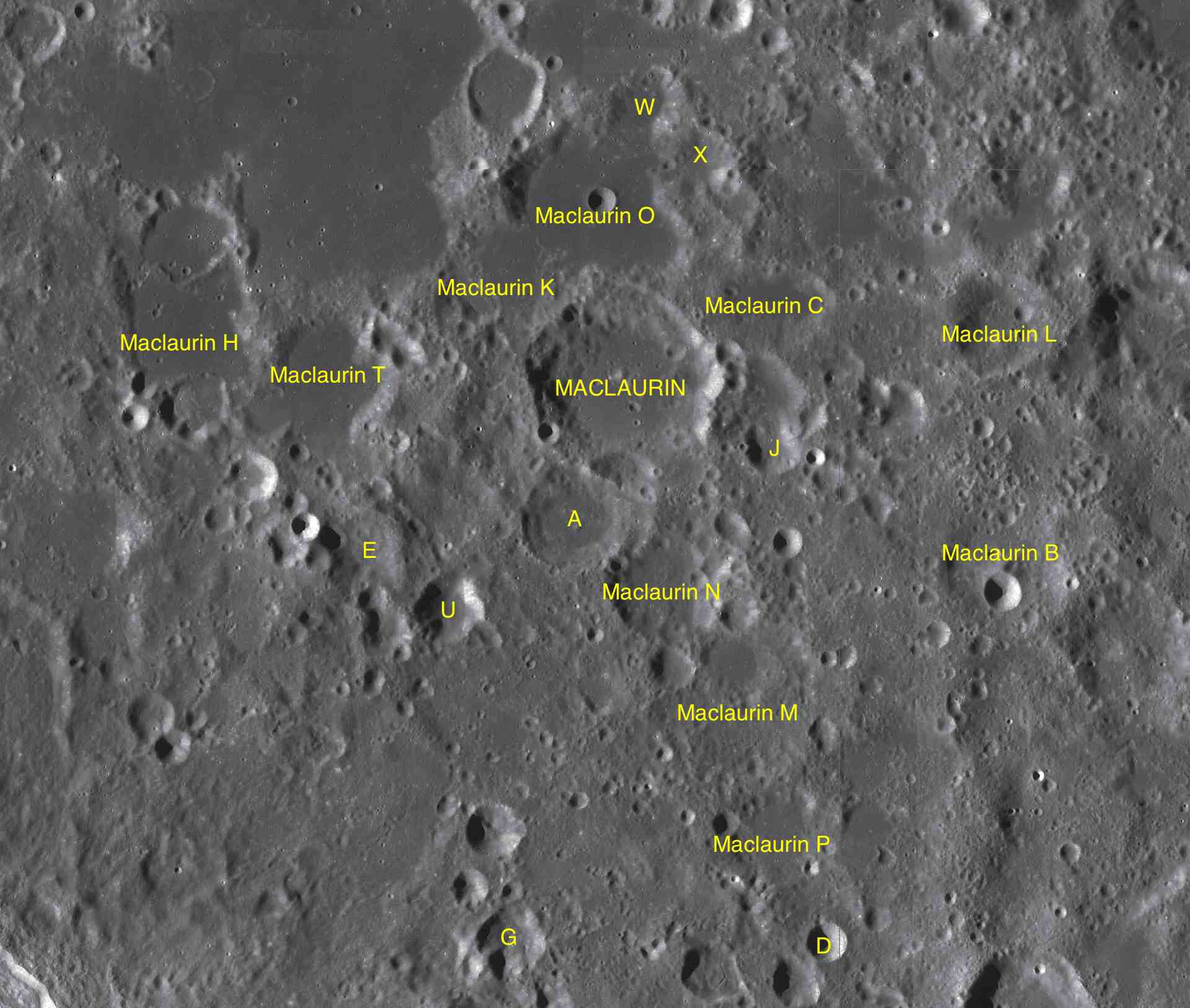
Craters Maclaurin X and Maclaurin O
Maclaurin X
Center: 68.708˚ E, 0.091˚ N
Range: 68.403˚ - 69.014˚ E, 0.214˚ S - 0.397˚ N
Crater
15 mi
Colin Maclaurin (1698-1746), Scottish mathematician
Maclaurin O
Center: 67.557˚ E, 0.135˚ S
Range: 66.873˚ - 68.241˚ E, 0.819˚ S - 0.548˚ N
Crater
23 mi
Colin Maclaurin (1698-1746), Scottish mathematician
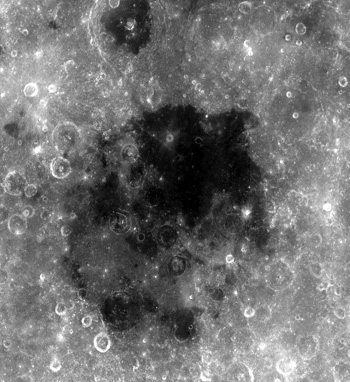
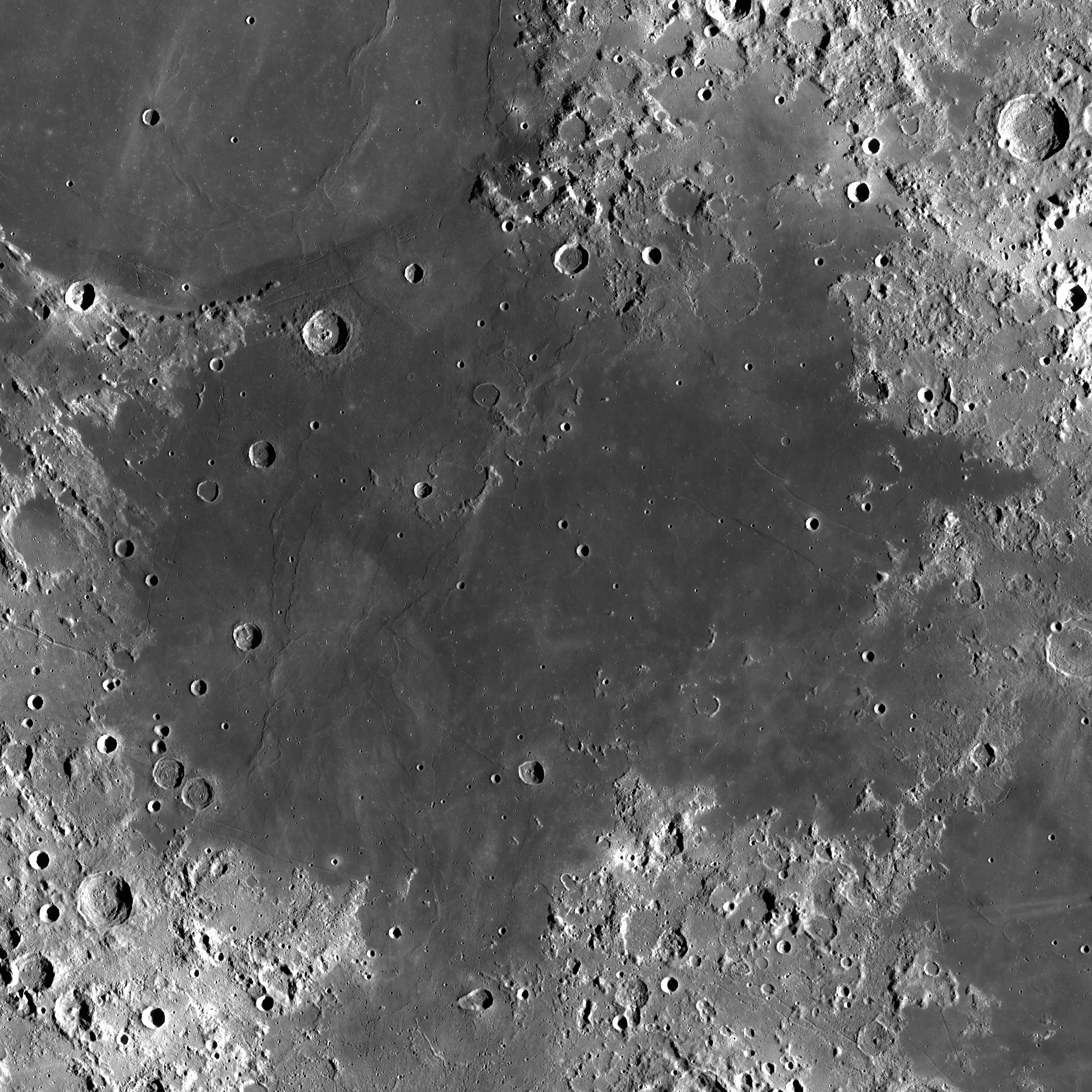
Mare Spumans, “The Foaming Sea”
Mare Spumans
Center: 65.303˚ E, 1.302˚ N
Range: 63.613˚ - 66.733˚ E, 1.062˚ S - 3.722˚ N
Mare
87 mi
The Foaming Sea
Crater Webb C
Webb C
Center: 63.833˚ E, 0.149˚ N
Range: 63.267˚ - 64.398˚ E, 0.247˚ S - 0.544˚ N
Crater
21 mi
Thomas William Webb (1807-1885), English astronomer
Sinus Successus
Center: 58.520˚ E, 1.124˚ N
Range: 56.519˚ - 60.188˚ E, 0.861˚ S - 2.872˚ N
Bay
82 mi
Bay of Success
Mare Fecunditatis, “Sea of Fertility”
Mare Fecunditatis
Center: 53.669˚ E, 7.835˚ S
Range: 40.771˚ - 63.340˚ E, 21.695˚ S - 6.112˚ N
Mare
429 mi, 1.1 mi
Sea of Fertility
Craterlet Taruntius P is on the left (Taruntius K is at right)
Taruntius P
Center: 51.585˚ E, 0.060˚ N
Range: 51.473˚ - 51.696˚ E, 0.051˚ S - 0.172˚ N
Craterlet
5 mi, 0.9 mi
Lucius Tarutius Firmanus (fl. 86 B.C.), Roman philosopher, mathematician, and astrologer
Wrinkle ridge Dorsum Cayeux, with craterlets Taruntius P (left) and Taruntius K (right) in the lower left
Dorsum Cayeux
Center: 51.220˚ E, 0.763˚ N
Range: 50.922˚ - 52.000˚ E, 0.598˚ S - 2.113˚ N
Wrinkle ridge
59 mi
Lucien Cayeux (1864-1944), French sedimentary petrographer
Wrinkle ridges Dorsa Cato (north is to the right in this Apollo 11 view)
Dorsa Cato
Center: 47.701˚ E, 0.213˚ N
Range: 46.605˚ - 49.599˚ E, 1.165˚ S - 2.233˚ N
Wrinkle ridges
87 mi
Marcus Porcius Cato (234-149 B.C.), Roman soldier, senator, and historian
Rima Messier
Center: 44.545˚ E, 0.756˚ S
Range: 43.357˚ - 45.581˚ E, 1.561˚ S - 0.015˚ N
Rille
62 mi
Charles Messier (1730-1817), French astronomer
Crater Lubbock R
Lubbock R
Center: 40.453˚ E, 0.167˚ S
Range: 40.060˚ - 40.845˚ E, 0.559˚ S - 0.225˚ N
Crater
15 mi
Sir John William Lubbock (1803-1865), English banker, barrister, mathematician, and astronomer
Maskelyne T & Maskelyne A (click on image for higher resolution view)
Maskelyne T
Center: 36.593˚ E, 0.040˚ S
Range: 36.507˚ - 36.678˚ E, 0.125˚ S - 0.046˚ N
Craterlet
3 mi
Nevil Maskelyne (1732-1811), English astronomer
Maskelyne A
Center: 34.089˚ E, 0.032˚ N
Range: 33.603˚ - 34.574˚ E, 0.453˚ S - 0.517˚ N
Crater
18 mi
Nevil Maskelyne (1732-1811), English astronomer
Mare Tranquillitatis, “Sea of Tranquility”
Mare Tranquillitatis
Center: 30.835˚ E, 8.349˚ N
Range: 16.924˚ - 45.490˚ E, 4.051˚ S - 19.375˚ N
Mare
544 mi
Sea of Tranquility
Rimae Hypatia
Center: 22.777˚ E, 0.340˚ S
Range: 19.690˚ - 25.975˚ E, 1.406˚ S - 0.672˚ N
Rilles
128 mi
Hypatia (c.370-415), Alexandrian philosopher, mathematician, and astronomer
Craters Lade A and Lade B
Lade A
Center: 12.726˚ E, 0.161˚ S
Range: 11.773˚ - 13.680˚ E, 1.114˚ S - 0.793˚ N
Crater
35 mi
Heinrich Eduard von Lade (1817-1904), German banker and amateur astronomer
Lade B
Center: 9.796˚ E, 0.016˚ N
Range: 9.412˚ - 10.180˚ E, 0.368˚ S - 0.399˚ N
Crater
15 mi
Heinrich Eduard von Lade (1817-1904), German banker and amateur astronomer
Craters Rhaeticus F, Rhaeticus, and Rhaeticus L
Rhaeticus F
Center: 6.438˚ E, 0.060˚ S
Range: 6.134˚ - 6.742˚ E, 0.364˚ S - 0.244˚ N
Crater
11 mi
Georg Joachim Rheticus (1514-1574), Austria-born astronomer & mathematician
Rhaeticus
Center: 4.924˚ E, 0.032˚ N
Range: 4.192˚ - 5.657˚ E, 0.701˚ S - 0.764˚ N
Crater
30 x 27 mi, 1.0 mi
Georg Joachim Rheticus (1514-1574), Austria-born astronomer & mathematician
Rhaeticus L
Center: 3.484˚ E, 0.205˚ N
Range: 3.257˚ - 3.711˚ E, 0.022˚ S - 0.432˚ N
Crater
9 mi
Georg Joachim Rheticus (1514-1574), Austria-born astronomer & mathematician
Sinus Medii
Center: 1.027˚ E, 1.634˚ N
Range: 3.371˚ W - 5.551˚ E, 2.048˚ S - 4.641˚ N
Bay
178 mi
Bay of the Center
Crater Mösting E
Mösting E
Center: 4.591˚ W, 0.178˚ N
Range: 5.189˚ - 3.992˚ W, 0.421˚ S - 0.777˚ N
Crater
27 mi
Johan Sigismund von Møsting (1759-1843), Danish banker, finance minister, and astronomy enthusiast
Crater Sömmering
Sömmering
Center: 7.526˚ W, 0.193˚ N
Range: 7.987˚ - 7.065˚ W, 0.268˚ S - 0.654˚ N
Crater
17 mi, 0.8 mi
Samuel Thomas von Sömmering (1755–1830),German physician and anatomist
Crater Lansberg
Lansberg
Center: 26.627˚ W, 0.312˚ S
Range: 27.266˚ - 25.988˚ W, 0.951˚ S - 0.327˚ N
Crater
24 mi, 1.9 mi
Philippe van Lansbergen (1561-1632), Dutch astronomer and mathematician
Mare Insularum
Center: 30.640˚ W, 7.792˚ N
Range: 39.195˚ - 22.153˚ W, 0.596˚ S - 16.345˚ N
Mare
318 mi
Sea of Islands
Oceanus Procellarum
Center: 56.677˚ W, 20.671˚ N
Range: 81.084˚ - 26.850˚ W, 16.266˚ S - 57.433˚ N
Mare
1611 x 353 mi
Ocean of Storms
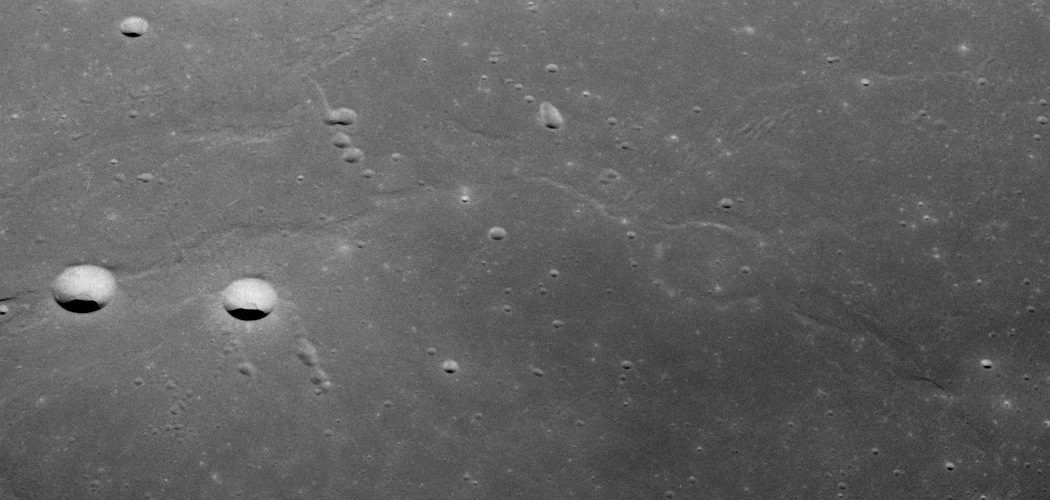
Crater Lohrmann D cut through by one of the rilles of Rimae Hevelius (arrow points to another part of Rimae Hevelius)
Lohrmann D
Center: 65.273˚ W, 0.141˚ S
Range: 65.442˚ - 65.104˚ W, 0.310˚ S - 0.028˚ N
Crater
7 mi
Wilhelm Gotthelf Lohrmann (1796-1840), German selenographer
Rimae Hevelius
Center: 66.377˚ W, 0.809˚ N
Range: 67.849˚ - 63.582˚ W, 1.284˚ S - 2.956˚ N
Rilles
113 mi
Johannes Hevelius (1611-1687), Polish astronomer
Crater Lohrmann
Lohrmann
Center: 67.383˚ W, 0.440˚ S
Range: 67.898˚ - 66.867˚ W, 0.955˚ S - 0.075˚ N
Crater
19 mi, 1.0 mi
Wilhelm Gotthelf Lohrmann (1796-1840), German selenographer
Rimae Riccioli
Center: 73.071˚ W, 1.515˚ S
Range: 76.809˚ - 68.566˚ W, 4.754˚ S - 1.247˚ N
Rilles
249 mi
Giovanni Battista Riccioli (1598-1671), Italian astronomer
Crater Schlüter P
Schlüter P
Center: 85.208˚ W, 0.054˚ N
Range: 85.550˚ - 84.865˚ W, 0.289˚ S - 0.397˚ N
Crater; libration zone
12 mi
Heinrich Schlüter (1815-1844), German astronomer
Now that we’ve taken a tour of nearside features along the equator, let us turn to the lunar north and south celestial poles. As you know, the Earth’s north celestial pole (NCP) is currently located quite close to Polaris. However, on the Moon, the NCP is located in Draco near the Cat’s Eye Nebula (NGC 6543), about two-thirds of the way between Polaris and the center of the Head of Draco.
The Moon’s NCP is located near the Cat’s Eye Nebula (NGC 6543), a fine planetary nebula in Draco.
The Moon’s south celestial pole (SCP) is located in the constellation Dorado inside of the Large Magellanic Cloud (LMC). If you were stationed at the south pole of the Moon, you would see the Large Magellanic Cloud directly overhead at all times!
The Moon’s SCP is located in the constellation Dorado within the Large Magellanic Cloud.
The Moon has many fascinating places, tempting us to explore. Some of them have quite interesting names. One of my favorites is Lacus Perseverantiae, Lake of Persistence. Its location is 62.0˚ E and 8.0˚ N. See if you can find it here. (Hint: under Layers : Overlays select Nomenclature, and under Settings select Show Graticule.) Have fun exploring!


![\delta _{gs}=\textup{tan}^{-1}\left [ 6.611\textup{ csc }\phi - \textup{cot }\phi \right ]-90^{\circ}](https://s0.wp.com/latex.php?latex=%5Cdelta+_%7Bgs%7D%3D%5Ctextup%7Btan%7D%5E%7B-1%7D%5Cleft+%5B+6.611%5Ctextup%7B+csc+%7D%5Cphi+-+%5Ctextup%7Bcot+%7D%5Cphi+%5Cright+%5D-90%5E%7B%5Ccirc%7D&bg=ffffff&fg=000&s=3&c=20201002)
![\delta _{gs}=\textup{tan}^{-1}\left [ \frac{6.611}{\textup{sin }\phi }-\frac{1}{\textup{tan }\phi } \right ]-90^{\circ}](https://s0.wp.com/latex.php?latex=%5Cdelta+_%7Bgs%7D%3D%5Ctextup%7Btan%7D%5E%7B-1%7D%5Cleft+%5B+%5Cfrac%7B6.611%7D%7B%5Ctextup%7Bsin+%7D%5Cphi+%7D-%5Cfrac%7B1%7D%7B%5Ctextup%7Btan+%7D%5Cphi+%7D+%5Cright+%5D-90%5E%7B%5Ccirc%7D&bg=ffffff&fg=000&s=3&c=20201002)
![\textup{h}=\textup{tan}^{-1}\left [ \frac{\textup{sin }\Delta\lambda }{\textup{cos }\Delta \lambda-0.15126\textup{ cos }\phi } \right ]](https://s0.wp.com/latex.php?latex=%5Ctextup%7Bh%7D%3D%5Ctextup%7Btan%7D%5E%7B-1%7D%5Cleft+%5B+%5Cfrac%7B%5Ctextup%7Bsin+%7D%5CDelta%5Clambda++%7D%7B%5Ctextup%7Bcos+%7D%5CDelta+%5Clambda-0.15126%5Ctextup%7B+cos+%7D%5Cphi++%7D+%5Cright+%5D&bg=ffffff&fg=000&s=3&c=20201002)
![\delta _{gs}=\textup{tan}^{-1}\left [ \frac{-0.15126\textup{ sin }\phi \textup{ sin h}}{\textup{sin }\Delta \lambda } \right ]](https://s0.wp.com/latex.php?latex=%5Cdelta+_%7Bgs%7D%3D%5Ctextup%7Btan%7D%5E%7B-1%7D%5Cleft+%5B+%5Cfrac%7B-0.15126%5Ctextup%7B+sin+%7D%5Cphi+%5Ctextup%7B+sin+h%7D%7D%7B%5Ctextup%7Bsin+%7D%5CDelta+%5Clambda+%7D+%5Cright+%5D&bg=ffffff&fg=000&s=3&c=20201002)