Where Voters Rejected Trump – II

Though Trump lost his 2020 re-election bid, the fact that he polled so well throughout the anything-but-United States clearly shows the “Party of Trump”—today’s Republican Party—is leading us towards something far more sinister. The Republican Party of our parents’ generation would never have elected such a damaged person to the highest office in our land. Trump’s narcissism, ineptitude, lying, corruption, nepotism, divisiveness, etc. has been an unmitigated nightmare these past four long years. If you haven’t watched it yet, I suggest you take the time to view the three-part documentary series Rise of the Nazis airing this month on PBS Wisconsin. There are parallels to what is happening in the U.S. today, and it is chilling.

As for the voters who continue to support this charade, we are witnessing in living color government by people who don’t believe in government—or good governance. The landscape looks pretty bleak in this country for progressives and intellectuals for the foreseeable future. Might want to leave while you still can.

Has the whole country gone mad? Well, not all of it. Here are the ten states where Trump and Trumpism were most soundly rejected in the 2020 election.

RankState% Voting for Trump
0.District of Columbia5.40%
1.Vermont30.67%
2.Maryland32.44%
3.Massachusetts32.49%
4.California34.24%
5.Hawaii34.27%
6.Rhode Island38.70%
7.Washington38.76%
8.Connecticut39.21%
9.Delaware39.78%
10.Illinois40.14%
States where Voters Most Rejected Trump in the 2020 Presidential Election

And here are the ten states you’ll probably want to think twice about moving to if you’re a progressive.

RankState% Voting for Trump
1.Wyoming69.94%
2.West Virginia68.63%
3.Oklahoma65.37%
4.North Dakota65.11%
5.Idaho63.81%
6.Arkansas62.39%
7.Alabama62.15%
8.Kentucky62.13%
9.South Dakota61.77%
10.Tennessee60.73%
States where Voters Most Supported Trump in the 2020 Presidential Election

Now, let’s return to the ten states that most soundly rejected Trump in the 2020 presidential election. Which county in each of these states had the smallest percentage voting for Trump?

State RankStateCounty% Voting for Trump
1.VermontChittenden County21.25%
2.MarylandPrince George’s County8.77%
3.MassachusettsSuffolk County17.8%
4.CaliforniaSan Francisco County12.72%
5.HawaiiHawaii County30.63%
6.Rhode IslandNewport County34.07%
7.WashingtonKing County22.22%
8.ConnecticutHartford County35.39%
9.DelawareNew Castle County30.72%
10.IllinoisCook County24.03%
Most Trump-Unfavorable Counties in States where Voters Most Rejected Trump in the 2020 Presidential Election

Polarization is tearing this country apart, but the blame does not equally fall on both sides. How do you talk with someone who all-too-willingly embraces conspiracy theories rather than reason, who derides science and scholars, who mistrusts or worse yet hates anyone who has a different spiritual viewpoint, let alone is a humanist, agnostic, or atheist? Who shows little or no interest in understanding perspectives other than their own?

May I submit for your consideration, the March 4, 1960 episode of The Twilight Zone, “The Monsters Are Due on Maple Street”.

The Monsters are Due on Maple Street

Figure One

Understand the procedure now? Just stop a few of their machines and radios and telephones and lawn mowers…throw them into darkness for a few hours and then you just sit back and watch the pattern.

Figure Two

And this pattern is always the same?

Figure One

With few variations. They pick the most dangerous enemy they can find…and it’s themselves. And all we need do is sit back…and watch.

Figure Two

Then I take it this place…this Maple Street…is not unique.

Figure One

[Shaking his head.] By no means. Their world is full of Maple Streets. And we’ll go from one to the other and let them destroy themselves. One to the other…one to the other…one to the other—

Narrator’s Voice

The tools of conquest do not necessarily come with bombs and explosions and fallout. There are weapons that are simply thoughts, attitudes, prejudices—to be found only in the minds of men. For the record, prejudices can kill and suspicion can destroy, and a thoughtless, frightened search for a scapegoat has a fallout all of its own for the children and the children yet unborn. [A pause.] And the pity of it is…that these things cannot be confined to…The Twilight Zone…

Written by Rod Serling

Why No New Einstein?

In the June 2005 issue of Physics Today there is an article by Lee Smolin with the provocative (or evocative) title, Why No ‘New Einstein’? That year marked the 100th anniversary of Albert Einstein‘s annus mirabilis (year of wonders), in which the 26-year-old Swiss patent examiner submitted and had published revolutionary papers on the photoelectric effect, Brownian motion, special relativity, and matter-energy equivalence in a prominent German physics journal, Annalen der Physik. These papers were so important that they completely changed the course of physics and led to great opportunities for Einstein to further develop his career as a physicist.

Here are some excerpts from Smolin’s article.

“Many of Einstein’s contemporaries testified that he was not unusually talented mathematically. Instead, what enabled him to make such tremendous advances was a driving need to understand the logic of nature, tied to a breathtaking creativity and a fierce intellectual independence.”

“Perhaps a lesson might be learned from the fact that this one person, who was initially unable to find an academic job, did more to advance physics than most of the rest of us [physicists] put together have since.”

“It follows that new Einsteins are unlikely to be easily characterized in terms of research programs that have been well explored for decades. Instead, a new Einstein will be developing his or her own research program that, by definition, will be one that no senior person works on.”

“Are our universities, institutes, and foundations doing all they can to identify and promote individuals who have the creativity and intellectual independence that characterize those who contribute most to physics? I say that they are not.”

“People with the uncanny ability to ask new questions or recognize unexamined assumptions, or who are able to take ideas from one field and apply them to another, are often at a disadvantage when the goal is to hire the best person in a given well-established area.”

“It is easy to write many papers when you continue to apply well-understood techniques. People who develop their own ideas have to work harder for each result, because they are simultaneously developing new ideas and the techniques to explore them. Hence they often publish fewer papers, and their papers are cited less frequently than those that contribute to something hundreds of people are doing.”

Prokofiev’s Last Symphony

Photograph of Sergei Prokofiev (1891-1953) Russian composer, pianist, and conductor. Dated 1950.

Sergei Prokofiev was truly one of the most remarkable composers of the 20th century. His signature disjunct melodies and quirky, perky compositional style is so interesting and unique that his music is instantly recognizable, even today. When critics complain that the wellspring of current musical idioms has become exhausted or derivative, along comes a composer like Prokofiev who surprises everyone and does something completely different. That is why I believe that even within established musical forms it is possible to invent something completely new and exciting—it just doesn’t happen very often.

Regrettably, no English-language documentary about the life and music of Prokofiev has ever been produced. While we wait for someone to do that, perhaps Robert Greenberg might add another excellent installment to his “Great Masters” series for The Great Courses by profiling Sergei Prokofiev in eight 30-minute episodes as he did for Shostakovich, Brahms, and others.

Sergei Prokofiev composed his last completed work, the Symphony No. 7, between December 1951 and July 1952 at the age of 60-61. Its first public performance in Moscow on October 11, 1952 would be the last public performance Prokofiev would attend. He died less than five months later.

Dmitri Shostakovich attended the premiere, and quickly sent a letter of congratulations to Prokofiev, “I wish you at least another hundred years to live and create. Listening to such works as your Seventh Symphony makes it much easier and more joyful to live.” Shostakovich would attend Prokofiev’s funeral in March 1953.

Iconic photo of the three greatest 20th-century Soviet composers, together. Sergei Prokofiev (1891-1953), Dmitri Shostakovich (1906-1975), and Aram Khachaturian (1903-1978). Dated 1940.

The most inspired recording I have ever heard of Prokofiev’s Seventh Symphony is by the Bergen Philharmonic Orchestra with Andrew Litton conducting. Even though I was already familiar with this work, listening to this performance was like hearing the work for the first time. This interpretation is intimate and compelling.

BIS-2134

The last years of Prokofiev’s life were difficult ones. His health was deteriorating and Stalin’s terrible regime was a constant threat and source of anxiety. Official disapproval had led to a life of poverty for Prokofiev.

With that as a backdrop, Prokofiev was eager that his new symphony would be well received by the authorities as well as the public, hoping that it would earn him a First Class Stalin Prize—he needed the money. But like Shostakovich, Prokofiev took his symphonies seriously, pouring his heart and soul into them while cleverly embedding what he wanted to say musically in a way that would elude the authorities with their limited musical sophistication and intelligence.

Prokofiev even wrote two endings for the symphony. The “real” ending and a contrived ending to please the authorities and help him win the prize. (He did not win the hoped for Stalin Prize, but he was posthumously awarded the Lenin Prize for this symphony in 1957.)

Prokofiev told his friend, the young cellist Mstislav Rostropovich, “Slava, you will live much longer than me, and you must take care that this new ending never exists after me.” As Andrew Huth writes in the liner notes, “Both versions of the ending are included on this disc so that listeners can judge the very different effect each makes.” Track 9 is the final movement of Symphony No. 7 played again with the alternative ending that Prokofiev wrote to please the authorities.

Mstislav Rostropovich (1927-2007) with Sergei Prokofiev

Satellites and More – 2020 #1

Edmund Weiss (1837-1917) and many astronomers since have called asteroids “vermin of the sky”, but on October 4, 1957 another “species” of sky vermin made its debut: artificial satellites.  In the process of video recording stars for possible asteroid occultations, I frequently see satellites passing through my 17 × 11 arcminute field of view.

I’ve put together a video montage of satellites I serendipitously recorded during the first half of 2020.  Many of the satellites move across the field as “dashes” because of the longer integration times I need to use for some of my asteroid occultation work. A table of these events is shown below the video. The range is the distance between observer and satellite at the time of observation. North is up and east is to the left.

North is up and east is to the left; field size 17′ x 11′

Interestingly, three of the above satellites (7,9,18) are in retrograde orbits, that is their orbital inclination is > 90˚ and their east-west component of motion is towards the west instead of the east. However, I was surprised to find that two of the prograde orbiting satellites (5,6) appear to be orbiting retrograde! Both have orbital inclinations close to 90˚ (82.6˚ and 87.5˚, respectively), and both were in the western sky at northern declinations at the time of observation. But another satellite (8) with an orbital inclination of 82.5˚ at a southern declination in the southern sky at the time of observation exhibited the expected “barely” prograde motion. I suspect the ~0.5 km/s rotation of the Earth towards the east might have something to do with this “apparent retrograde” motion, but I was unable to find any reference that describes this situation.

Satellite #12 has an interesting story. It is the Inertial Upper Stage (IUS) used to launch USA-48 (Magnum), a classified DoD payload, from the Space Shuttle Discovery (STS-33).

In addition to these 18 satellites, I observed 7 geosynchronous satellites, shown below.

This non-operational Soviet communications satellite is a “tumbler”, meaning its changing orientation causes variation in its brightness, as shown below.

This non-operational communications satellite is also a tumbler, as seen in this light curve from a portion of the video.

SGDC-1 is a Brazilian geostationary communications satellite stationed over longitude 75˚ W, and in this video is followed by Star One C3 which will replace Brasilsat B3, also located over longitude 75˚ W.
Star One C3, a geostationary television satellite led by SGDC-1 and followed by GOES-16.
GOES-16, a geostationary weather satellite that is the primary weather satellite for the U.S., is stationed over longitude 75.2˚ W. Star One C3 precedes it in this video.
Intelsat 16 is a geostationary television satellite stationed over longitude 76˚ W currently.

There were four satellites I was unable to identify, shown in the video below. They were either classified satellites or, more likely, small pieces of space debris that only government agencies or contractors are keeping track of.

Unidentifiable satellites

Occasionally, I record other phenomena of interest. Meteors during this period are described here, and you will find a couple of other curiosities below.

An aircraft with flashing lights passed near the field containing UCAC4 376-101735 between 10:06:44 and 10:06:47 UT on 16 Apr 2020.
High energy particles zap the imaging chip from time to time, and here is one of the more interesting ones during the period, recorded on 9 May 2020 from 9:09:18 – 9:09:20 UT in the field of UCAC4 397-127754.

References
Hughes, D. W. & Marsden, B. G. 2007, J. Astron. Hist. Heritage, 10, 21

Repurposing an Existing Community

One approach to establishing a dark-sky, astronomy-friendly, community is to find a small town in a rural area that would be receptive to doing the following:

  1. Enact a comprehensive lighting ordinance that will be enforced
  2. Eliminate all dusk-to-dawn outdoor lighting
  3. Apply for International Dark Sky Community status

Obviously, this is going to be easier to do in a small community, and most likely one that is economically depressed.

What’s in it for them? What would the motivating factors be?

  • A commitment from X number of people that they would move to the community provided the community agrees to 1-3 above being done. Options for new residents would be to either purchase or rent an existing home/apartment/RV space/etc., or to build the same but land would have to be available.
  • The new residents would commit to working with the existing residents and businesses to improve the community and provide new opportunities, ensuring that this is a win-win situation for both existing and new residents.
  • The new residents would commit to doing some or all of the things outlined in the Mirador Astronomy Village specifications document, or something like it.
  • The influx of new residents and tourism will benefit all in the community, both economically and socially.

Does anyone know of a rural community that might be interested in putting their town “on the map” as an astronomy-friendly community for residents and visitors?

The Great Divide

A few quotes come to mind when considering the current hyperpartisan and politically polarized environment in the United States.

“The beatings will continue until morale improves.” – Anonymous

“Insanity is doing the same thing over and over again and expecting different results.” – Albert Einstein

“Human history becomes more and more a race between education and catastrophe.” – H. G. Wells

One thing is for sure. The systemic problems in our political system will remain firmly in place no matter who wins the election.

I want to live in a place where we can work together, despite our differences, to make real progress towards the following goals:

  • Free or inexpensive basic healthcare not tied to one’s employer
  • Free or inexpensive post-secondary education
  • Affordable housing and tiny house villages for the homeless
  • Universal Basic Income (UBI)
  • An economy based on building things that last and are able to be repaired or recycled, rather than rapidly consumed and thrown away
  • Currency that is neither artificially scarce nor debt-based, and that takes into account everything of value to society
  • Public policy based on a humanistic worldview where decisions are guided by facts not faith, science not religion
  • A gradual reduction in the world’s population through the only humane way available—having fewer children
  • Tight restrictions on gun ownership and training requirements for those who do own guns
  • Binding and enforceable international laws
  • A stronger and more effective United Nations
  • A completely decentralized power grid powered by renewable energy sources, primarily solar and wind
  • Substantially scale back on the use of fossil fuels
  • A strong public transportation system, including high-speed passenger rail

I’m sure those of you of a similar persuasion could add many more items to this list, but you get the idea which “side” I am on. (Hint: It is not the side that has most of the guns.)

There are many people who want these things. Wouldn’t it be nice if we could live someplace where we could work towards these goals without our every effort being blocked?

We have built a lifestyle that is economically and ecologically unsustainable. We are fast running out of time and options. Smart people address problems before they get to be crises.

What are our options, besides a slow, miserable, and probably violent descent into dystopia (i.e. life’s a bitch and then you die)?

  1. Divide the U.S. into autonomous enclaves
  2. Leave the U.S. (if anyone will have us)
  3. Form or join an intentional community where people with similar goals and beliefs can demonstrate to the wider world a better way to live, a better way to govern

1 and 3 are similar, but 3 would be on a much smaller scale—no more than about 150 people. Small is beautiful.

A few years ago, at a friend’s recommendation, I watched a movie based on a brilliant idea but crudely executed (and I do mean crudely): Idiocracy. It seems we are already well on the way to the dystopian existence portrayed in that 2006 movie. Though Idiocracy is brilliant satire, I would love to see a remake that is more discerning and family friendly so it can reach a wider audience.

There’s a great divide in my life, too. On the one hand, I want to finally live far away from city lights during my retirement years in an astronomy-friendly intentional community that has no dusk-to-dawn lighting. But on the other hand, I would love to live in a politically progressive city with a first-rate symphony orchestra and a vibrant classical music scene. Observational astronomy and classical music are my two biggest interests, but their venues are mutually incompatible.

Challenges, large and small.

Imagine

John Lennon

Imagine there’s no heaven
It’s easy if you try
No hell below us
Above us, only sky

Imagine all the people
Livin’ for today
Ah

Imagine there’s no countries
It isn’t hard to do
Nothing to kill or die for
And no religion, too

Imagine all the people
Livin’ life in peace
You

You may say I’m a dreamer
But I’m not the only one
I hope someday you’ll join us
And the world will be as one

Imagine no possessions
I wonder if you can
No need for greed or hunger
A brotherhood of man

Imagine all the people
Sharing all the world
You

You may say I’m a dreamer
But I’m not the only one
I hope someday you’ll join us
And the world will live as one

First Photograph of the Orion Nebula

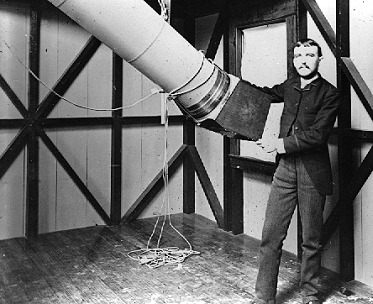
Henry Draper (1837-1882)

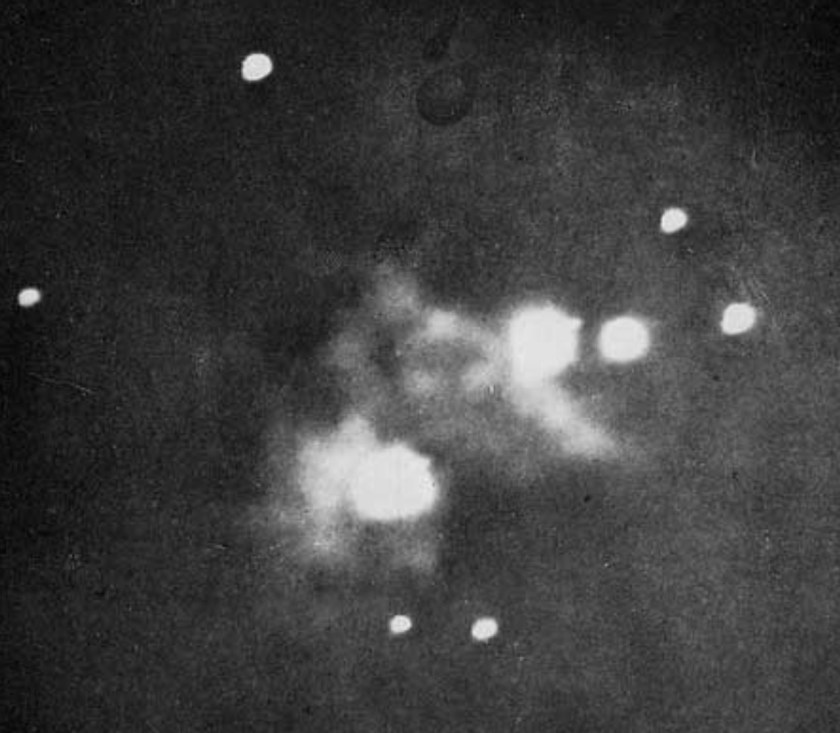
On this date 140 years ago, American physician and prominent amateur astronomer Henry Draper (1837-1882) made the first successful photograph of the Great Nebula in Orion, now usually referred to as the Orion Nebula. He used an 11-inch telescope (an Alvan Clark refractor!) and an exposure time of 50 minutes for the black and white photograph.

First photograph of the Orion Nebula, September 30, 1880. (Henry Draper)

Draper continued to improve his technique, and a year and a half later he obtained a 137-minute exposure showing much more detail.

Photograph of the Orion Nebula, March 14, 1882. (Henry Draper)

It really is amazing how image recording technology has improved over the past century and a half! At its best, film-based photography had a quantum efficiency of only about 2%, which means that only 2 out of every 100 photons of light impinging on the photographic medium is actually recorded. The rest is reflected or absorbed. The human eye—when well dark adapted—has a quantum efficiency of 15% or better, easily besting photography. Why, then, do photographs of deep sky objects show so much more detail than what can be seen through the eyepiece? The explanation is that the human eye can integrate photons and hold an image for only about 0.1 second. Film, on the other hand, can hold an image much longer. Even with reciprocity failure, photographic media like film can collect photons for minutes or even hours, giving them a big advantage over the human eye. But charge-coupled devices (CCDs) are a considerable improvement over older technologies since they typically have a quantum efficiency of 70% up to 90% or more. The CCD has truly revolutionized both professional and amateur astronomy in recent decades.

Recent Orion Nebula CCD image by Robert Gendler

Luna 16: First Robotic Lunar Sample Return Mission

Fifty years ago this day, the Soviet Union’s Luna 16 robotic probe made a night landing in the Sea of Fertility. It drilled nearly 14 inches into the lunar regolith, collected 3.6 ounces of soil, and delivered its precious cargo to Earth four days later.

The astronauts on Apollo 11, 12, 14, 15, 16, and 17 between 1969 and 1972 brought back a total of 840 lbs of moon rocks and soil. Each successive Apollo mission brought back a larger amount of lunar material.

The Soviets brought back a total of 0.7 lbs of lunar soil through their robotic sample return missions Luna 16 (1970), Luna 20 (1972), and Luna 24 (1976).

So, excluding lunar meteorites that have befallen the Earth, a total of 840.7 lbs of lunar material has been brought to research laboratories here on Earth.

After a hiatus of over 44 years, China plans to launch two lunar sample return missions, Chang’e 5 in November 2020 and Chang’e 6 in 2023 or 2024. Chang’e 5 is expected to return at least 4.4 lbs of lunar material from nearly 7 ft. below the surface at its landing site in the Mons Rümker region of Oceanus Procellarum.

Chang’e is the Chinese goddess of the Moon, and is pronounced chong-EE.

Joaquín Rodrigo: The (Almost) Complete Music for Piano

Recently, I wrote about the extraordinary orchestral music of 20th-century Spanish composer Joaquín Rodrigo (1901-1999). In that piece, I lauded a collection of Rodrigo’s orchestral work, all conducted by the esteemed Mexican conductor Enrique Bátiz with three different orchestras. Today, I would like to share with you the best and most complete recordings of Rodrigo’s piano music, a two-disc set by Gregory Allen and Anton Nel (two piano and piano four hands works).

I wish other music CDs had as much detail about each of the pieces as the enclosed booklet by Gregory Allen and Linton Powell has, nicely indexed by CD track in the margins of the narrative. They write: “The present recordings represent the first complete collection of Rodrigo’s original piano music for two and four hands, omitting only a few transcriptions and lost early works.” In a footnote, they detail the works that are excluded. I am familiar with only one of these, the Cinco piezas del siglo XVI of 1937, which is worth seeking out.

At the end of the documentary Shadows and Light, made when Rodrigo was 90, there is a spellbinding performance of Zarabanda lejana (Distant Sarabande) of 1926. I’m pretty sure the recording they used was the one on these discs. The tempo and sensitivity of this performance is perfect. I have another recording that seems rushed by comparison, and it ruins the mood.

Here we have 2 hours and 33 minutes of delightful piano music composed by Joaquín Rodrigo, sure to increase your appreciation for this great 20th-century composer. Of course, I have a number of favorites.

  • Zarabanda lejana (Distant Sarabande)
  • Cinco piezas infantiles (Five children’s pieces), for two pianos
  • Sonatina para dos Muñecas (Sonatina for two Puppets), for piano four hands
  • Gran Marcha de los Subsecretarios (Grand March of the Subsecretaries), for piano four hands
  • Atardecer (Dusk), for piano four hands
  • À l’ombre de Torre Bermeja (In the Shadow of the Crimson Tower)
  • Plegaria de la Infanta de Castilla (Prayer of the Princess of Castile), from Cuatro piezas para piano

If you need any more convincing that this recording is a “must have”, here are words written by Joaquín Rodrigo himself.

“Gregory Allen’s recording of my works for piano is excellent. His magnificent technique and his authentically fine interpretation satisfy me completely.”

—Joaquín Rodrigo, Madrid, 1991

Video Meteors 2020 – I

During the first half of 2020, I serendipitously captured a whopping nine meteors on my telescope’s 17 x 11 arcminute video field of view while observing potential asteroid occultation events. I used the method described in There’s a Meteor in My Image to determine the radiant for each meteor. Here they are.

Antihelion meteor 22 March 2020 UT; Field location UCAC4 575-024067 in Gemini
Each frame is an exposure of 0.53s

The International Meteor Organization (IMO) identifies the antihelion source as “a large, roughly oval area of about 30˚ in right ascension and 15˚ in declination, centered about 12˚ east of the solar opposition point on the ecliptic, hence its name. It is not a true shower at all, but is rather a region of sky in which a number of variably, if weakly, active minor showers have their radiants.”

Sporadic meteor 10 Apr 2020 UT, Field location HD 119307 in Centaurus
Each frame is an exposure of 0.13s

A sporadic meteor is any meteor that does not come from a known radiant.

Sporadic meteor 14 Apr 2020 UT, Field location UCAC4 387-065649 in Libra
Each frame is an exposure of 0.27s (faint meteor in the upper right corner)
Possible Eta Aquariid meteor 28 April 2020 UT; Field location UCAC4 326-064938 in Corvus
Each frame is an exposure of 0.13s
Sporadic meteor or satellite? 8 May 2020 UT; Field location UCAC4 345-084929 in Ophiuchus
Each frame is an exposure of 0.03s

Meteors enter the Earth’s atmosphere at a speed between 10 and 70 km/s, and burn up at an altitude of about 80 km. For a sight line perpendicular to the meteor’s path, the angular velocity should range between 7˚ and 41˚ per second. This means a meteor should cross the 17′ x 11′ field of my video camera in 0.03 seconds or less. Field traversal will take longer than this the closer the meteor is to its radiant or anti-radiant point.

The lowest stable altitude a satellite can orbit is about 200 km, where it will have an orbital velocity on the order of 8 km/s. This is slower than the slowest meteors. For a sight line perpendicular to the satellite’s path, the maximum angular velocity a satellite should have is about 2˚ per second.

Given these admittedly BOTEC calculations, one could reasonably conclude that if the object traverses the field in a single frame, it is probably a meteor. If not (and it is not an airplane), it is a satellite.

The object in the 8 May 2020 video does appear to be moving slow enough to be a satellite, but because it is traveling much faster than satellites usually do it must be orbiting quite low, close to re-entry. I was not able to identify the satellite, which is often the case for the fastest-moving satellites. My camera is sensitive enough to pick up tiny pieces of space debris orbiting at low altitude, and though these objects are no doubt catalogued by military organizations, they do not generally show up in the publicly-available orbital element datasets for satellites.

Antihelion meteor or satellite? 12 May 2020 UT; Field location UCAC4 585-130160 in Pegasus
Each frame is an exposure of 0.27s

This one’s unusual in that there are two distinct “flare-ups” along the path. It is reasonably good match to the antihelion radiant for 12 May 2020, and though I have seen meteors experiencing outbursts along their paths, a more likely explanation for this event is that it is low altitude satellite with two “sun glint” events. What do you think?

Sporadic meteor 13 May 2020 UT; Field location UCAC4 348-150732 in Sagittarius
Each frame is an exposure of 0.53s
Antihelion meteor 17 June 2020 UT; Field location UCAC4 294-088825 in Lupus
Each frame is an exposure of 1.07s
Sporadic meteor 18 June 2020 UT; Field location UCAC4 330-150629 in Sagittarius
Each frame is an exposure of 0.53s

I was surprised to record so many meteors during the first half of 2020, as there is generally much less meteor activity between January and June than there is between July and December.

References

International Meteor Organization, 2o2o Meteor Shower Calendar, Jürgen Rendtel, ed. https://www.imo.net/files/meteor-shower/cal2020.pdf.