Classical Music Timeline: 1850s

This is one of a series of postings of important classical music dates, from the 17th century to the present. Included are the date and location of the birth and death of composers, and the premiere date and location of the first public performance of works. When the premiere date and location is unknown, the date or year of completion of the work is given. Though reasonably comprehensive, this is a subjective list, so the choice of composers and works is mine. If you find any errors, or if you can offer a premiere date and location for a work where only the completion date or year is listed, please post a comment here.

1850
Camille Saint-Saëns (1835-1921) completed Symphony in A major

September 21 – Hans Sitt (1860-1922) was born in Prague, Czech Republic

November 17 – String Quintet in C major, D. 956, op. posth. 163, by Franz Schubert (1797-1828) was first performed in Vienna, Austria

1851
February 6 – Symphony No. 3 in E♭ major, op. 97, “Rhenish”, by Robert Schumann (1810-1856) was first performed in Düsseldorf, Germany

March 27 – Vincent d’Indy (1851-1931) was born in Paris, France

1852
Robert Schumann (1810-1856) completed his final revision of the Symphonic Etudes, op. 13, for piano

March 14 – Manfred Overture, op. 115, by Robert Schumann (1810-1856) was first performed in Leipzig, Germany

November 21 – Francisco Tárrega (1852-1909) was born in Villarreal, Spain

1853
March 6 – Prelude, Act 1, from the opera La Traviata by Giuseppe Verdi (1813-1901) was first performed in Venice, Italy

May 15 – The 2nd version of Symphony No. 4 in D minor, op. 120 (much preferred by Clara Schumann and most often performed today) by Robert Schumann (1810-1856) was first performed in Düsseldorf, Germany

1854
February 23 – Les préludes, S. 97, symphonic poem by Franz Liszt (1811-1886) was first performed in Weimar, Germany

February 27 – Robert Schumann (1810-1856) attempted to drown himself in the Rhine River and, after being rescued, committed himself to a sanatorium in the Endenich quarter of Bonn, Germany, remaining there for the rest of his life.

July 3 – Leoš Janáček (1854-1928) was born in Hukvaldy, Czech Republic

September 1 – Engelbert Humperdinck (1854-1921) was born in Siegburg, Germany

December – Piano Sonata No. 3 in F minor, op. 5 by Johannes Brahms (1833-1897) was first performed in its entirety in Magdeburg, Germany

1855
January 20 – Ernest Chausson (1855-1899) was born in Paris, France

February 17 – Piano Concerto No. 1 in E♭ major, S. 124, by Franz Liszt (1811-1886) was first performed in Weimar, Germany

May 12 – Anatoly Lyadov (1855-1914) was born in Saint Petersburg, Russia

June 13 – Overture to the opera I vespri siciliani by Giuseppe Verdi (1813-1901) was first performed in Paris, France

December 3 – Piano Trio in G minor, op. 15, by Bedřich Smetana (1824-1884) was first performed in Prague, Czech Republic

1856
Mikhail Glinka (1804-1857) completed the orchestral version of Valse-Fantaisie, in B minor

May 26 – George Templeton Strong (1856-1948) was born in New York, New York

July 29 – Robert Schumann (1810-1856) died in Bonn, Germany

1857
January 7 – Piano Concerto No. 2 in A major, S. 125, by Franz Liszt (1811-1886) was first performed in Weimar, Germany

February 15 – Mikhail Glinka (1804-1857) died in Berlin, Germany

June 2 – Edward Elgar (1857-1934) was born in Lower Broadheath, Worcestershire, England

September 5 – A Faust Symphony, S. 108, by Franz Liszt (1811-1886) was first performed in Weimar, Germany

1858
Camille Saint-Saëns (1835-1921) completed Piano Concerto No. 1 in D major, op. 17

April 22 – Ethel Smyth (1858-1944) was born in Sidcup, England

November 24 – Tritsch-Tratsch Polka in A major, op. 214, by Johann Strauss II (1825-1899) was first performed in Vienna, Austria

1859
January 22 – Piano Concerto No. 1 in D minor, op. 15, by Johannes Brahms (1833-1897) was first performed in Hanover, Germany

November 19 – Mikhail Ippolitov-Ivanov (1859-1935) was born in Gatchina, Russia

December 2 – Ave Maria, in F major, op. 12, by Johannes Brahms (1833-1897) was first performed in Hamburg, Germany

1840s

1860s

Classical Music Timeline: 1840s

This is one of a series of postings of important classical music dates, from the 17th century to the present. Included are the date and location of the birth and death of composers, and the premiere date and location of the first public performance of works. When the premiere date and location is unknown, the date or year of completion of the work is given. Though reasonably comprehensive, this is a subjective list, so the choice of composers and works is mine. If you find any errors, or if you can offer a premiere date and location for a work where only the completion date or year is listed, please post a comment here.

1840
May 7 – Pyotr Ilyich Tchaikovsky (1840-1893) was born in Votkinsk, Russia

September 30 – Johan Svendsen (1840-1911) was born in Oslo, Norway

1841
January 18 – Emmanuel Chabrier (1841-1894) was born in Ambert, France

March 31 – Symphony No. 1 in B♭ major, op. 38, “Spring”, by Robert Schumann (1810-1856) was first performed in Leipzig, Germany

September 8 – Antonín Dvořák (1841-1904) was born in Nelahozeves, Czech Republic

October 17 – Symphony No. 5 in B♭ major, D. 485, by Franz Schubert (1797-1828) was first performed in Vienna, Austria

December 6 – The 1st version of Symphony No. 4 in D minor, op. 120 (much preferred by Johannes Brahms) by Robert Schumann (1810-1856) was first performed in Leipzig, Germany

1842
Louise Farrenc (1804-1875) completed Symphony No. 1 in C minor, op. 32

March 3 – Symphony No. 3 in A minor, op. 56, “Scottish”, by Felix Mendelssohn (1809-1847) was first performed in Leipzig, Germany

March 9 – Sinfonia from the opera Nabucco by Giuseppe Verdi (1813-1901) was first performed in Milan, Italy

May 12 – Jules Massenet (1842-1912) was born in Saint-Étienne, France

December 9Ruslan and Lyudmila, opera by Mikhail Glinka (1804-1857), was first performed in Saint Petersburg, Russia

1843
January 8 – Piano Quintet in E♭ major, op. 44 by Robert Schumann (1810-1856) was first performed in Leipzig, Germany

June 15 – Edvard Grieg (1843-1907) was born in Bergen, Norway

1844
Frédéric Chopin (1810-1849) completed Piano Sonata No. 3 in B minor, op. 58

February 21 – Charles-Marie Widor (1844-1937) was born in Lyon, France

March 10 – Pablo de Sarasate (1844-1908) was born in Pamplona, Spain

March 18 – Nikolai Rimsky-Korsakov (1844-1908) was born in Tikhvin, Russia

December 8 – Piano Quartet in E♭ major, op. 47 by Robert Schumann (1810-1856) was first performed in Leipzig, Germany

1845
Charles Auguste de Bériot (1802-1870) completed the Violin Concerto No. 8 in D major, op. 99

Mikhail Glinka (1804-1857) completed Capriccio brillante on the Jota aragonesa, Spanish Overture No. 1

March 13 – Violin Concerto in E minor, op. 64, by Felix Mendelssohn (1809-1847) was first performed in Leipzig, Germany

May 12 – Gabriel Fauré (1845-1924) was born in Pamiers, France

December 4 – Piano Concerto in A minor, op. 54 by Robert Schumann (1810-1856) was first performed in Dresden, Germany

1846
November 5 – Symphony No. 2 in C major, op. 61 by Robert Schumann (1810-1856) was first performed in Leipzig, Germany

1847
Louise Farrenc (1804-1875) completed Symphony No. 3 in G minor, op. 36

Frédéric Chopin (1810-1849) completed Waltz in C♯ minor, op. 64, no. 2

November 4 – Felix Mendelssohn (1809-1847) died in Leipzig, Germany

1848
Franz Liszt (1811-1886) completed Liebeslied (“Love Song”), S. 566 (for piano); transcription of Widmung (“Devotion”) from Myrthen, op. 25, no. 1 (song) by Robert Schumann (1810-1856)

1849
Robert Schumann (1810-1856) completed the Romances and Ballads, op. 75, for SATB choir a cappella

Franz Liszt (1811-1886) completed Three Concert Studies, S. 144, for piano

March – Robert Schumann (1810-1856) completed the Romances, op. 69, for female voices (SSAA) a cappella

March – Robert Schumann (1810-1856) completed the Romances, op. 91, for female SSAA choir a cappella

October 17 – Frédéric Chopin (1810-1849) died in Paris, France

November 19 – Symphony No. 4 in C minor, D. 417, “Tragic”, by Franz Schubert (1797-1828) was first performed in Leipzig, Germany

December 8 – Sinfonia from the opera Luisa Miller by Giuseppe Verdi (1813-1901) was first performed in Naples, Italy

1830s

1850s

Classical Music Timeline: 1830s

This is one of a series of postings of important classical music dates, from the 17th century to the present. Included are the date and location of the birth and death of composers, and the premiere date and location of the first public performance of works. When the premiere date and location is unknown, the date or year of completion of the work is given. Though reasonably comprehensive, this is a subjective list, so the choice of composers and works is mine. If you find any errors, or if you can offer a premiere date and location for a work where only the completion date or year is listed, please post a comment here.

1831
Frédéric Chopin (1810-1849) completed Étude in C minor, op. 10, no. 12, “Revolutionary”

1832
Frédéric Chopin (1810-1849) completed Three Nocturnes, op. 9

Frédéric Chopin (1810-1849) completed Étude in E major, op. 10, no. 3, “Tristesse”

May 14 – Overture to The Hebrides, in B minor, op. 26, by Felix Mendelssohn (1809-1847) was first performed in London, England

November 15 – Symphony No. 5 in D minor, op. 107 “Reformation” by Felix Mendelssohn (1809-1847) was first performed in Berlin, Germany

1833
Frédéric Chopin (1810-1849) completed Four Mazurkas, op. 17

May 7 – Johannes Brahms (1833-1897) was born in Hamburg, Germany

November 12 – Alexander Borodin (1833-1887) was born in Saint Petersburg, Russia

1834
Frédéric Chopin (1810-1849) completed Fantasie Impromptu in C♯ minor, op. 66

November 23Harold in Italy, op. 16, H. 68, by Hector Berlioz (1803-1869) was first performed in Paris, France

1835
October 9 – Camille Saint-Saëns (1835-1921) was born in Paris, France

November 9 – Piano Concerto in A minor, op. 7, by Clara Schumann (1819-1896) was first performed in Leipzig, Germany

1836
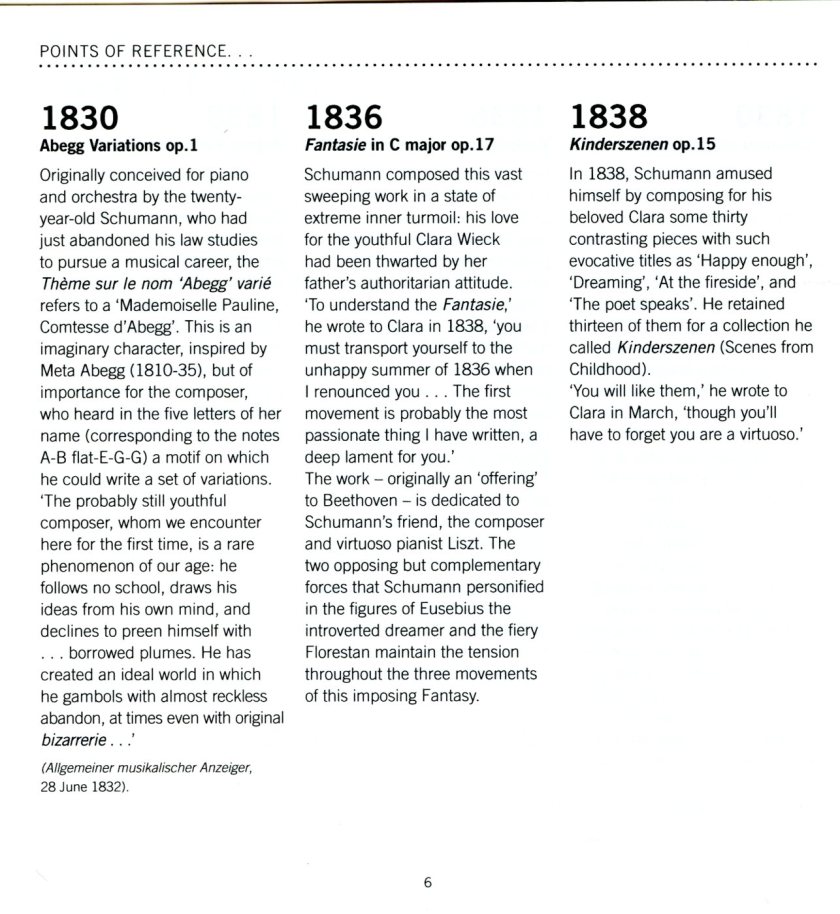
Robert Schumann (1810-1856) completed Fantasie in C major, op. 17

January 30 – Octet for Strings in E♭ major, op. 20, by Felix Mendelssohn (1809-1847) was first performed in Leipzig, Germany

February 21 – Léo Delibes (1836-1891) was born in Saint-Germain-du-Val (La Flèche), France

December 9A Life for the Tsar, opera, by Mikhail Glinka (1804-1857) was first performed in Saint Petersburg, Russia

1837
Frédéric Chopin (1810-1849) completed Étude in C minor, op. 25, no. 12, “Ocean”

January 2 – Mily Balakirev (1837-1910) was born in Nizhny Novgorod, Russia

June 23 – Ernest Guiraud (1837-1892) was born in New Orleans, Louisiana

1838
Frédéric Chopin (1810-1849) completed Prelude in A minor, op. 28, no. 2

Frédéric Chopin (1810-1849) completed Prelude in E minor, op. 28, no. 4

Robert Schumann (1810-1856) completed Scenes from Childhood, op. 15

January 6 – Max Bruch (1838-1920) was born in Cologne, Germany

October 25 – Georges Bizet (1838-1875) was born in Paris, France

1839
Frédéric Chopin (1810-1849) completed Prelude in D♭ major, op. 28, no. 15, “Raindrop”

Frédéric Chopin (1810-1849) completed Prelude in C minor, op. 28, no. 20

Frédéric Chopin (1810-1849) completed Piano Sonata No. 2 in B♭ minor, op. 35

March 21 – Symphony No. 9 in C major, D. 944 “The Great” by Franz Schubert (1797-1828) was first performed in Leipzig, Germany

March 21 – Modest Mussorgsky (1839-1881) was born in Karevo, Russia

November 24Roméo et Juliette, a choral symphony, op. 17 by Hector Berlioz (1803-1869) was first performed in Paris, France

1820s

1840s

Classical Music Timeline: 1810s

This is one of a series of postings of important classical music dates, from the 17th century to the present. Included are the date and location of the birth and death of composers, and the premiere date and location of the first public performance of works. When the premiere date and location is unknown, the date or year of completion of the work is given. Though reasonably comprehensive, this is a subjective list, so the choice of composers and works is mine. If you find any errors, or if you can offer a premiere date and location for a work where only the completion date or year is listed, please post a comment here.

1810
Ludwig van Beethoven (1770-1827) completed Piano Sonata No. 26 in E♭ major, op. 81a, “Les Adieux”

March 1 – Frédéric Chopin (1810-1849) was born in Żelazowa Wola, Poland

June 8 – Robert Schumann (1810-1856) was born in Zwickau, Saxony, Germany

1811
January 13 – Piano Concerto No. 5 in E♭ major, op. 73 by Ludwig van Beethoven (1770-1827) was first performed in Vienna, Austria

October 22 – Franz Liszt (1811-1886) was born in Raiding, Austria

1812
January 14 – Symphony No. 1 in C major, op. 19 (J. 50) by Carl Maria von Weber (1786-1826) was first performed in Leipzig, Germany

1813
May 22 – Richard Wagner (1813-1883) was born in Leipzig, Germany

October 9 – Giuseppe Verdi (1813-1901) was born in Le Roncole, Italy

October 28 – Franz Schubert (1797-1828) completed Symphony No. 1 in D major, D. 82

December 8 – Symphony No. 7 in A major, op. 92 by Ludwig van Beethoven (1770-1827) was first performed in Vienna, Austria

1814
February 27 – Symphony No. 8 in F major, op. 93 by Ludwig van Beethoven (1770-1827) was first performed in Vienna, Austria

August 16 – Ludwig van Beethoven (1770-1827) completed Piano Sonata No. 27 in E minor, op. 90

1815
July 19 – Franz Schubert (1797-1828) completed Symphony No. 3 in D major, D. 200

1819
Franz Schubert (1797-1828) completed Piano Quintet in A major, D. 667 “Trout”

September 13 – Clara Wieck [later Schumann] (1819-1896) was born in Leipzig, Germany

1800s

1820s

Brahms – Symphony No. 3

Johannes Brahms (1833-1897)

If I had to choose a single favorite composer, it would have to be Johannes Brahms. Among his many works, he wrote four symphonies, and every one of them is an absolute treasure. The only other composer that wrote at least four symphonies that shares that distinction, in my opinion, is Robert Schumann. Every one of Robert Schumann’s four symphonies is also a treasure. If you haven’t already done so, I encourage you to listen carefully to all eight of these symphonies. Robert Schumann’s profound musical influence on Brahms is frequently evident.

Robert Schumann (1810-1856)
Symphony No. 1 in B♭ Major (1841)
Symphony No. 2 in C Major (1846)
Symphony No. 3 in E♭ Major (1850)
Symphony No. 4 in D minor (1841; 1851)

Johannes Brahms (1833-1897)
Symphony No. 1 in C minor (1855-1876)
Symphony No. 2 in D Major (1877)
Symphony No. 3 in F Major (1883)
Symphony No. 4 in E minor (1884)

One of the joys of collecting classical CDs for many years is going back to some of the older recordings in the music library and falling in love with them all over again. This week, it was a 1983 Deutsche Grammophon disc (410 083-2) of Leonard Bernstein and the Vienna Philharmonic performing the Brahms Third Symphony, and the Variations on a Theme by Joseph Haydn. The premiere of the Brahms Symphony No. 3 was 100 years earlier by this same orchestra, on 2 December 1883. The conductor was Hans Richter.

The Brahms Third Symphony is a masterful work by a mature and confident composer, full of interesting musical ideas and—if you listen carefully—some adventuresome idiosyncrasies.

In the first bars of the first movement, the symphony’s noble main theme is introduced, profound and inspired.

Brahms – Symphony No. 3: I. Allegro con brio (beginning)

Ambivalence resolves to tenderness at the conclusion of the second movement.

Brahms – Symphony No. 3: II. Andante (ending)

This excerpt from the third movement shows how Brahms moves gracefully from one musical idea to the next, propelling us forward to unexpected places and always holding our interest. It has been suggested that the rhythmic dissonance of the “bouncy” passages was inspired by Brahms’ fondness for Romani (gypsy) music.

Brahms – Symphony No. 3: III. Poco Allegretto (excerpt)

At the end of the symphony we return to the theme introduced at its beginning, now gloriously transformed, and surely transformative for the listener.

Brahms – Symphony No. 3: IV. Allegro (ending)

This fine CD by Bernstein and the Vienna Philharmonic concludes with the Variations on a Theme by Joseph Haydn, written ten years earlier, in 1873. Notably, this work also received its premiere by the Vienna Philharmonic, on 2 November 1873, conducted by Johannes Brahms himself.

Unknown to Brahms (or anyone at the time), the “Chorale St. Antoni” theme upon which this work was based was probably not written by Joseph Haydn. Its origins remain a mystery.

The “Chorale St. Antoni” theme is followed by eight variations, and then a finale. The sixth variation is my favorite:

Brahms – Variations on a Theme by Joseph Haydn, op. 56a, Variation VI: Vivace

Some Early Piano Music by Robert Schumann

Naïve V 5364

I discovered the music of Johannes Brahms before that of Robert Schumann, but I revere the latter composer now as well. Knowing much of the music of both, there is no question that Robert Schumann had a huge influence on Brahms. Both wrote four symphonies, all eight of which are favorites of mine.

But here we turn our attention to some of the early piano music of Robert Schumann, completed when Schumann was in his 20s, before he was finally able to marry Clara Wieck, and before his first symphony.

These are performances of considerable beauty, passion, and sensitivity by French pianist Lise de la Salle. I highly recommend this CD (Naïve V 5364). The recording is excellent, and De la Salle seems to have an innate understanding of this music and its often rapidly changing moods, a delight throughout.

The works performed are Scenes from Childhood, op. 15; Abegg Variations, op. 1; and Fantasie in C Major, op. 17.

There are thirteen pieces in Scenes from Childhood. The most famous of these is No. 7 Träumerei (Dreaming), but I also especially like No. 1 (Of foreign lands and peoples) and No. 2 (A curious story).

  1. Of foreign lands and peoples
  2. A curious story
  3. Blind man’s buff
  4. Pleading child
  5. Happy enough
  6. An important event
  7. Dreaming
  8. At the fireside
  9. Knight of the hobby-horse
  10. Almost too serious
  11. Frightening
  12. Child falling asleep
  13. The poet speaks

This is followed by the Schumann’s first published work, the Abegg Variations, op. 1.

The disc concludes with the three-movement work, Fantasie in C Major, op. 17, arguably Schumann’s piano masterpiece, and a real tour de force in this performance by Lise de la Salle. When he wrote this piece, Schumann was already beginning to suffer from a mental disorder that would tragically claim his life only 20 years later—an illness with a physical origin that no doubt today could be easily cured.

For an excellent introduction to Robert Schumann and his wife, Clara Wieck Schumann—a piano virtuoso, composer, and teacher of considerable talent—I wholeheartedly recommend the eight-part video course from Robert Greenberg, “Great Masters: Robert and Clara Schumann – Their Lives and Music” (The Great Courses, Course No. 759).

Even though it is a highly fictionalized account, I would also recommend the 1947 movie Song of Love, starring the incomparable Katharine Hepburn as Clara Wieck Schumann, Paul Henreid as Robert Schumann, and Robert Walker as Johannes Brahms.